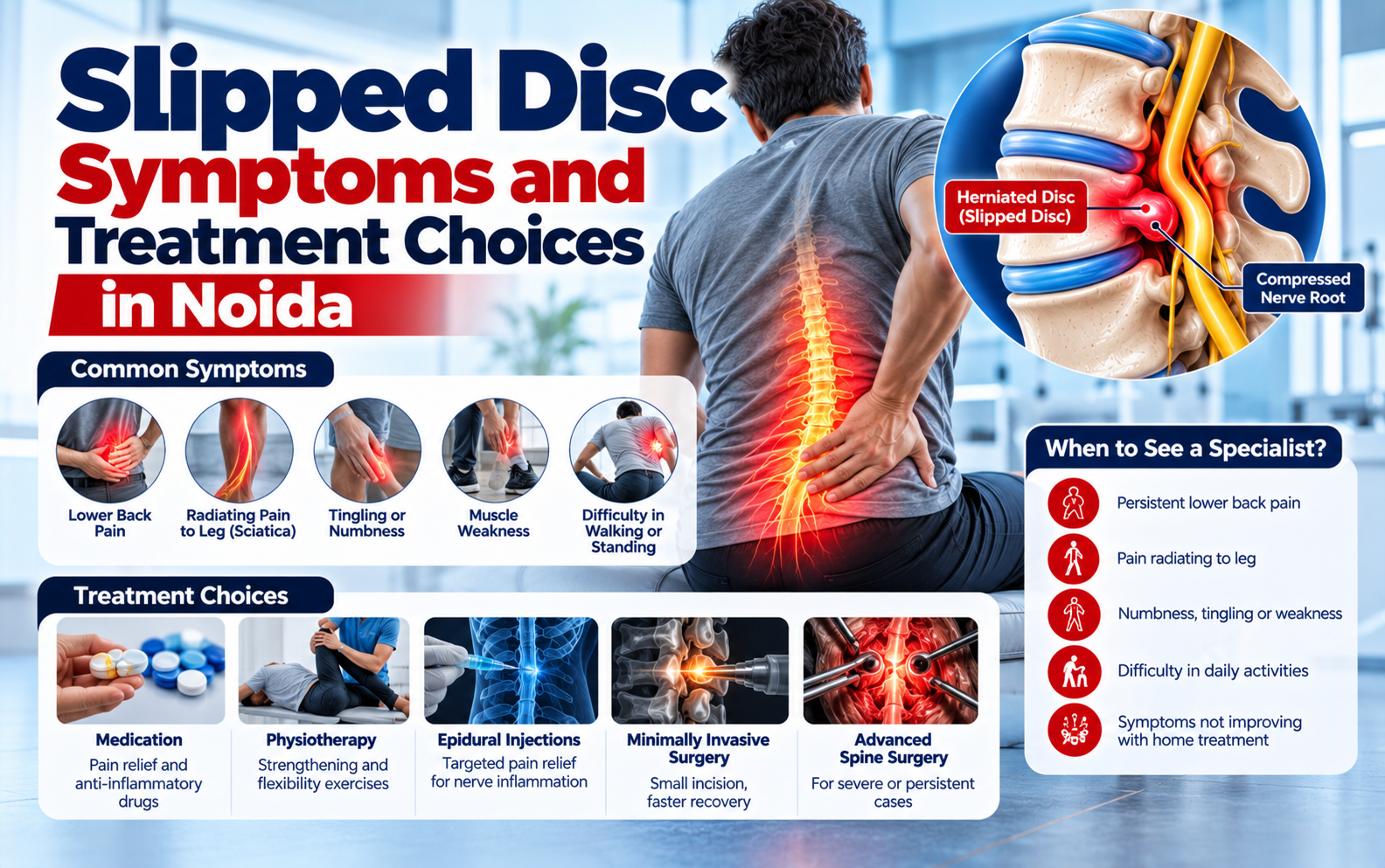
A slipped disc can irritate or compress a spinal nerve, but an MRI finding does not always explain every pain symptom.
Introduction and why this subject matters
A slipped disc can irritate or compress a spinal nerve, but an MRI finding does not always explain every pain symptom. Readers searching for slipped disc treatment in Noida often want a straightforward explanation of what a symptom, report or treatment recommendation means. A useful medical article should first identify the clinical question, then explain what is known, what remains uncertain and where personal assessment changes the answer. General information is helpful preparation, but it cannot determine whether any one person needs surgery.
This Noida-focused patient guide explores slipped disc symptoms and treatment choices in noida with an emphasis on symptom patterns, diagnosis, treatment conversations and safe next steps. It is designed for patients and families who may have just received a report or are trying to organise a consultation. The aim is to help you ask better questions rather than reach a diagnosis from a checklist.
Typical nerve-related symptoms
Leg pain spreading below the knee, numbness, tingling or certain types of weakness can suggest lumbar nerve root irritation. It is useful to think about the full timeline rather than one isolated symptom or result. Consider when the issue began, how quickly it developed, whether it is stable or changing, and how it affects ordinary activities. Small details such as a new fall, a change in handwriting, repeated headaches or a shift in speech can be important when relevant to the concern.
In the context of slipped disc treatment in Noida, there is rarely a single feature that answers every question. A clinician considers symptoms alongside the medical history, examination and any available investigations. If something seems worse than it was when the previous scan was taken, say so explicitly. A new clinical change may alter the need for reassessment even if a report uses familiar or mild-sounding terms.
Understanding symptoms without assuming a diagnosis
Symptoms that lead people to investigate slipped disc symptoms and treatment choices in noida can overlap with several different medical problems. Depending on the clinical concern, a doctor may ask about persistent neck or back pain, radiating arm or leg symptoms, altered sensation, weakness or a change in walking ability. The same symptom can have very different explanations, so it is unwise to identify a condition solely from an online description. Duration, severity and associated neurological changes often provide more context than the label attached to the symptom.
Difficulty with walking, working, sleep, hand use or day-to-day self-care helps describe how seriously the condition affects life. Describe the specific task that has become harder and how often the problem occurs. A family member may notice changes the patient has not recognised. A clear description can also help distinguish persistent symptoms from brief episodes, and can direct attention to signs that need emergency rather than routine assessment.
How doctors confirm the cause
Symptom location, physical examination and MRI findings are assessed together. Many patients initially benefit from activity guidance and appropriate nonsurgical treatment. Appropriate evaluation may involve neurological examination, MRI of the relevant spinal region and sometimes X-rays, CT or targeted investigations. The point of testing is to answer a defined question, not simply to collect more reports. An examination might identify a pattern that explains why a scan is important, or it might show that a different cause should be considered. The treating team will interpret findings in relation to the person in front of them.
When looking at imaging, ask which finding is most relevant, whether it explains the symptoms and whether any additional investigation would actually change management. An image shows anatomy at a moment in time; the clinical history reveals how function has changed. Both deserve attention. Written reports and the original images should be carried to appointments whenever they are available.
How specialists weigh possible explanations
A medical opinion usually develops through stages. The clinician first considers the urgency of the symptoms, then examines the likely source and decides whether more information is needed. They may compare alternative diagnoses, review medicines that could affect symptoms, or ask whether a previous illness changes the interpretation. This process can be more valuable than immediately choosing a named treatment.
For someone researching slipped disc treatment in Noida, uncertainty does not mean that the concern is unimportant. It means that decisions should match the strength of the available evidence. A finding can be monitored while additional information is gathered if the situation is stable. Conversely, a rapid change in neurological function may warrant urgent escalation rather than prolonged observation.
When surgery may enter the discussion
Persistent disabling sciatica or progressive neurological deficits may warrant an assessment of procedures such as microdiscectomy. Depending on the diagnosis and clinical situation, pathways may include monitoring, medicines, structured rehabilitation, targeted injections when indicated and surgery for selected problems. It is important to separate the options that are technically possible from those that offer a reasonable balance of benefit and risk in a particular case. Some patients improve without an operation, while other conditions can progress or require more urgent treatment.
Read our related information on microdiscectomy for slipped disc for an overview of one possible clinical pathway. That connection is educational only: reading about a procedure does not imply that it is necessary, available or appropriate for you. Treatment planning should include both the expected benefits and the limitations of each option, together with the risks of delaying care when those are relevant.
What treatment discussions should include
A good discussion explains the intended outcome in language the patient understands. Is the goal to establish a diagnosis, reduce pressure on a nerve, treat a vascular problem, control seizures or protect neurological function? The answer depends on the underlying condition. A meaningful conversation also covers the alternatives, potential complications, recovery needs and the possibility that some symptoms will remain after treatment.
In situations involving slipped disc treatment in Noida, be cautious of absolute promises or advice based only on one image. An appropriate recommendation should be connected to examination findings and the person’s medical circumstances. When risks are discussed, ask which are most relevant for the proposed option rather than treating every possible complication as equally likely.
Preparing documents for a consultation in Noida
Before a planned appointment, arrange recent prescriptions, medical history, relevant blood tests, imaging reports and the actual scan files if available. Write a short account of the problem in chronological order, including important dates and any previous treatment. If you have tried physiotherapy, medicine or another approach, explain what changed and what did not. A concise account can help a specialist identify gaps more efficiently.
For a discussion about slipped disc symptoms and treatment choices in noida, patients may find it helpful to take a family member or caregiver who can listen and ask questions. Decide in advance which two or three issues are most important: diagnosis, treatment necessity, recovery, work, driving, travel or long-term follow-up. A conversation that addresses those priorities is usually more useful than one focused only on medical jargon.
Risks, expected outcomes and recovery planning
The potential risks of a neurological procedure depend on the diagnosis, anatomy and treatment method. Depending on the approach, considerations may include infection, bleeding, injury to a nerve or spinal cord, persistent symptoms, spinal fluid leakage or complications related to anaesthesia. The presence of a risk does not prove that treatment should be avoided, just as the availability of a procedure does not prove that it should be performed. Comparing the risks of treatment against the risks of the untreated condition is part of shared decision-making.
Where intervention takes place, recovery plans may include wound care, an individual mobility plan, sensible activity progression and review of any new weakness or sensory changes. The timetable differs from person to person. Ask which warning signs require a call, when review imaging is planned and what support may be needed at home. Understanding follow-up before treatment begins can prevent confusion and help set practical expectations.
When symptoms require emergency care
An article about slipped disc symptoms and treatment choices in noida cannot assess an emergency. Warning signs that need urgent medical attention may include rapidly progressing weakness, new difficulty controlling bladder or bowel function or loss of sensation around the saddle area. If a person has a possible stroke, suspected brain bleeding, rapidly advancing weakness or prolonged seizure, contact emergency services or go to an appropriate emergency department immediately. Do not wait for an elective clinic slot, website reply or a routine telephone callback.
It is especially important to distinguish sudden neurological change from a stable problem being investigated over weeks or months. If you are uncertain and symptoms are severe or rapidly worsening, emergency assessment is safer than self-diagnosis. A hospital team can identify the immediate priorities and involve the appropriate specialists as needed.
Making sense of a second opinion
For non-emergency decisions, an additional clinical opinion can sometimes clarify alternative approaches, explain the uncertainty and help patients feel better informed. Bring the same source material to both appointments so that the recommendations can be compared fairly. Ask each clinician to explain how they linked the clinical picture to a proposed course of action. Different recommendations may reflect different assumptions, experiences or patient priorities.
If the subject is slipped disc treatment in Noida, the most useful comparison is often not which clinician sounds more confident but which explanation addresses the exact diagnosis, expected benefit, risks and follow-up. A second opinion should never be used to delay treatment for an acute neurological emergency.
Practical questions and next steps
Which structure is causing my symptoms, does the MRI match the examination, and what is likely to happen without surgery? It also helps to ask what change should prompt a new scan or faster assessment, whether medicine needs to be continued, and how rehabilitation or follow-up fits into the plan. Patients should be able to describe the next step in plain language when leaving a consultation. If the explanation remains confusing, ask for a summary or a diagram showing the relevant anatomy.
People in Noida researching slipped disc treatment in Noida can start by organising their symptoms and records, confirming the current consultation venue and listing the questions that matter most to them. Dr. Yashpal Singh Bundela’s professional profile mentions brain, spine and neurovascular expertise; individual treatment choices still require specialist review. This article is educational content, not a personal recommendation or a promise of a specific treatment.
Common questions from patients and families
Does reading about slipped disc treatment in Noida mean I need a procedure? No. A treatment is considered only after a diagnosis and an individual benefit-risk discussion. Many complaints have multiple possible explanations, and a consultation may lead to monitoring, medical care, rehabilitation, further testing or surgery depending on findings.
What should I do if the information in my scan report seems alarming? Arrange a timely review with the appropriate clinician and bring the images, not just the written description. If you also have sudden weakness, speech trouble, a thunderclap headache or a similar emergency sign, bypass a routine appointment and seek hospital emergency services immediately.
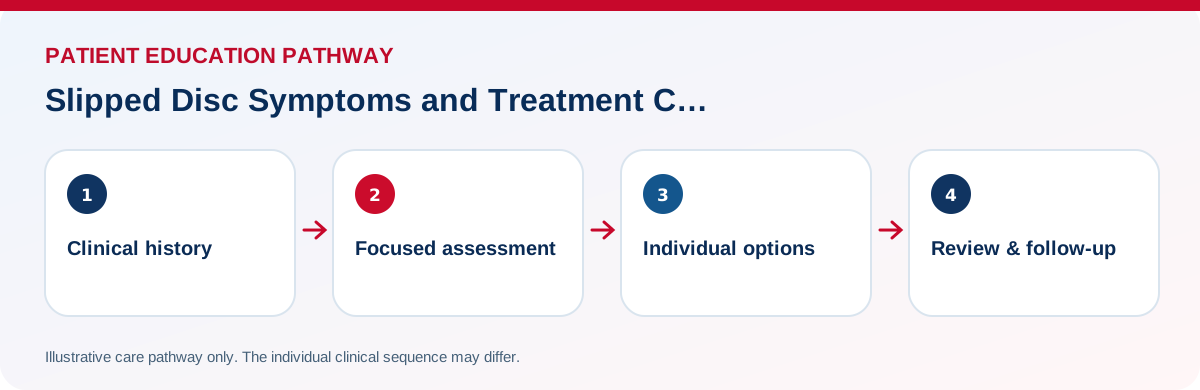
Organise your records and request a specialist discussion in Noida.